ON THE SHORE OF BRINE AND BINARY
Oliver Udeküll
Supervised by Ranno Ait
BA Graduation Project
EKA Graphic Design
2026
On the Shore of Brine and Binary is an interactive installation responding to the practice of artist Kristina Õllek through web development and programming. It explores how the organic in form, texture, and motion, can emerge from the computer's strictly deterministic logic. The project is a research into her practice, approached from my position as a graphic designer and web developer, and precedes our collaboration on designing her website. Central to it is the question of translating identity from one medium to another, specifically how to express a practice rooted in materiality within a digital environment.
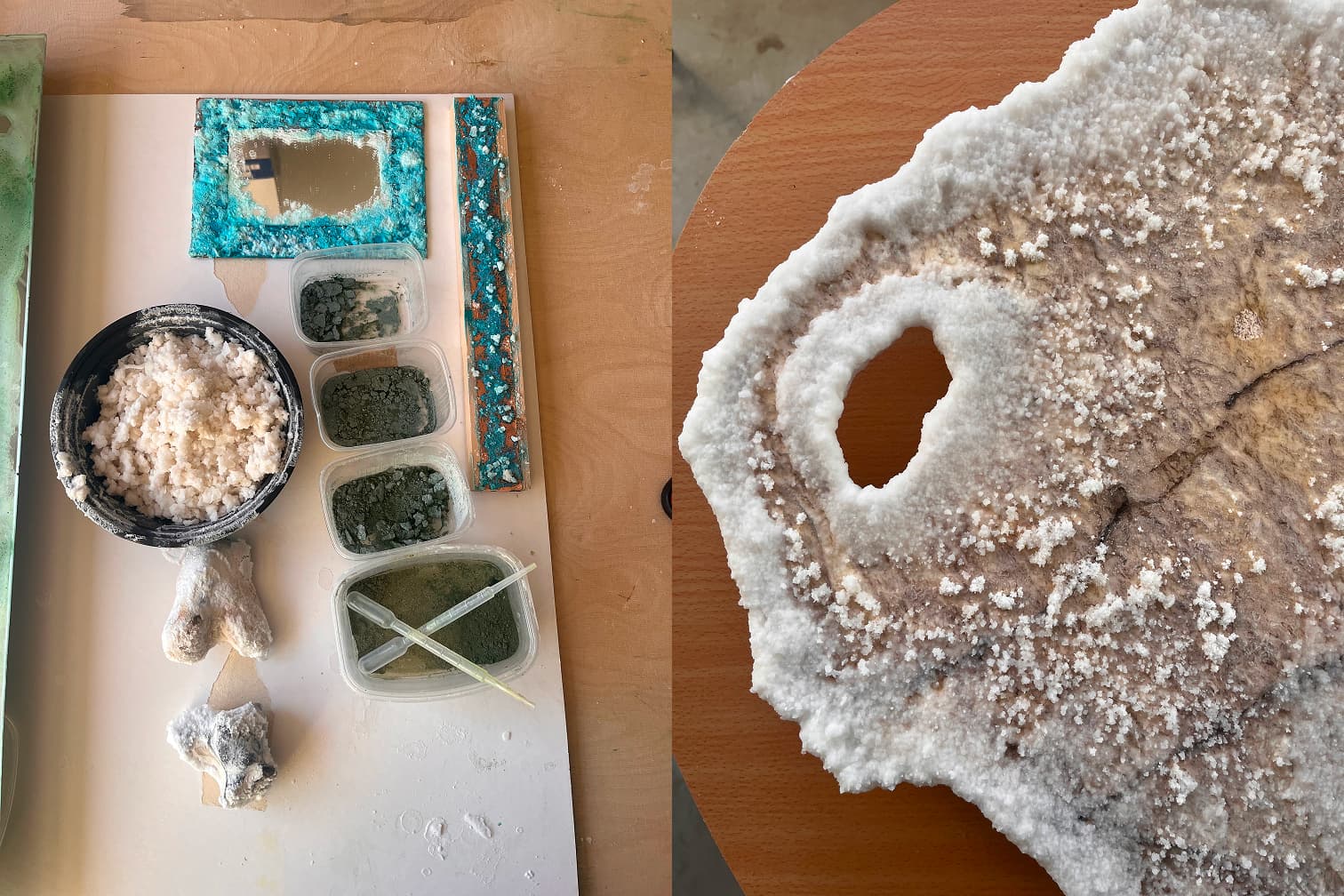
Kristina Õllek is a visual artist based in Tallinn, Estonia. She's working with photography, moving image, installation, as well as microbial and chemical processes, with a focus on investigating aquatic ecosystems, geological matter, and the human-altered environments. In her practice she uses a scientific and research-based approach, but within she also incorporates her own fictional and speculative perspectives. In particular, she's focused on the marine habitat and the notion of new technologies, including the geopolitical and ecological conditions associated with them. Within the past nine years, her work has engaged with the fragile ecosystem of the deep sea, been floating on the coasts of the North Sea, sunken into the hypoxic zones of the Baltic Sea; and thinking with the aquatic organisms, such as cyanobacteria, as well as the filter feeders, the living archives of our aquatic environment.
The architecture of the internet is surprisingly aligned with her practice, as it is deeply dependent on the ocean. We have been led to imagine the internet as something immaterial, transmitted invisibly via satellites and cell towers, a perception reinforced by labels such as "the cloud" and the iconography built around them. In reality, the vast majority of global internet traffic moves through submarine communications cables laid across ocean floors, an infrastructure dating to the 1850s and still very much in active expansion, with companies now developing undersea data centres for more cost-efficient cooling and reduced land use. This was also the reason for using a real server for the installation, one that has hosted Estonian internet traffic for years. It is one of the thousands hidden away in dark basements heated up by the loud machines.

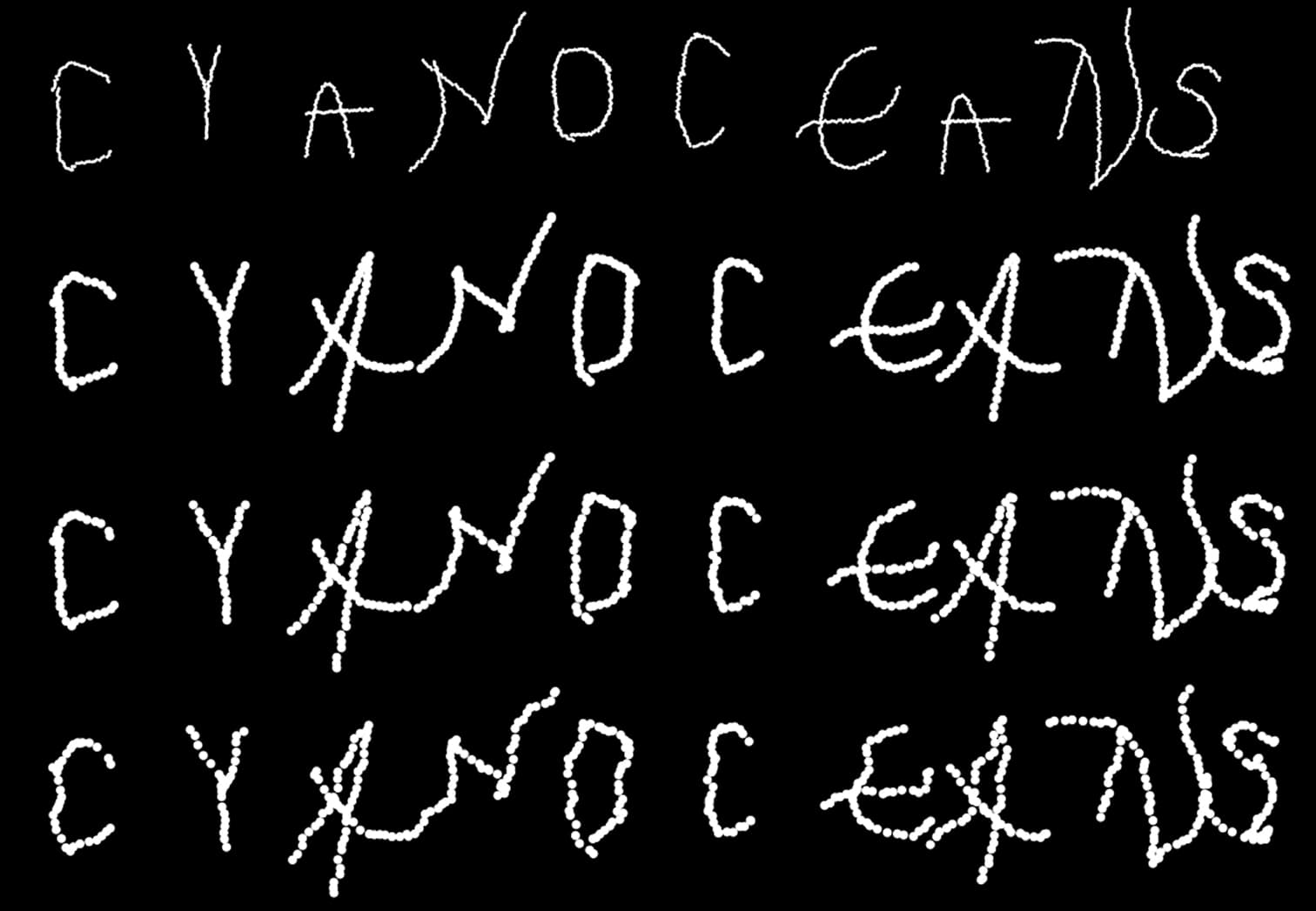
As Kristina works predominantly with organic materials and uncontrollable techniques, her practice creates an interesting juxtaposition with code as a material. Computers are deterministic machines incapable of producing true randomness. Instead, they simulate it through pseudorandom number generators, which algorithmically produce sequences of seemingly random numbers derived from variables such as the current time, thermal noise, CPU jitter, and user input timing. This mechanism, combined with various noise algorithms, became my primary technique for synthesising organic forms and textures. Kristina has also developed a style of writing that imitates the filamentous body of cyanobacteria, using dotted lines to construct unique letterforms, realised through techniques such as engraving letters dot by dot into the wooden frames of her works or growing salts into these shapes. Because the letterforms do not repeat, creating a conventional font was not an option. Instead, I built a generator that converts text input into her writing. I traced existing letterforms from her works, created variations of each letter, and converted these into point coordinates used to render paths, which were then resolved into sequences of dots morphed by noise algorithms, with controls for dot size, density, path jitter, and noise distortion.
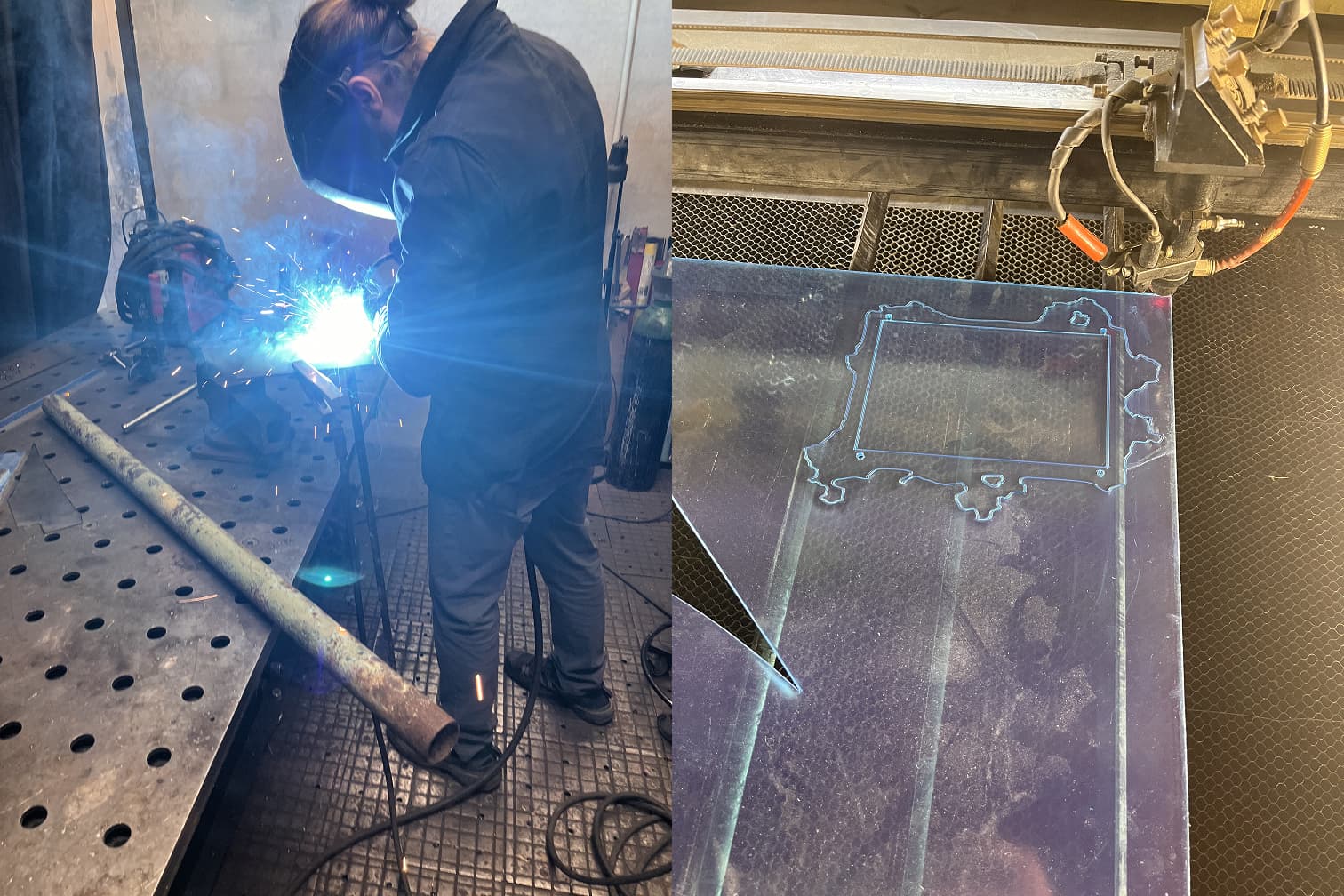
The installation takes physical form through rusted steel and laser cut plexiglass shaped by noise algorithms. This material choice mirrors the tension at the heart of the project. Kristina's practice is built on relinquishing control, working with biological processes that express themselves. When she grows salts, she sets the conditions but cannot determine the outcome. Code offers the opposite—total control, applied at every level. Through noise, randomness and careful parameterisation, it can be pushed toward the appearance of the organic, but it can never truly let go.
I would like to thank Kristina Õllek, who spent many hours with me introducing her practice and world, my tutor Ranno Ait, Andree Paat who lent me his monitor for the installation, Ardi Jürgens from Zone Media who let me use one of their server machines, Daria Kadushkina for helping with logistics, and everyone else involved in discussing, giving feedback and helping me realise this project.